How to Read a Supplement Facts Label
Start at the serving size. Then read each declared amount in the context of that serving, check whether a Daily Value appears, and review the rest of the package. The worked example below transcribes selected facts from IRIDISYN’s published softgels catalog so you can practice before reading your own label.
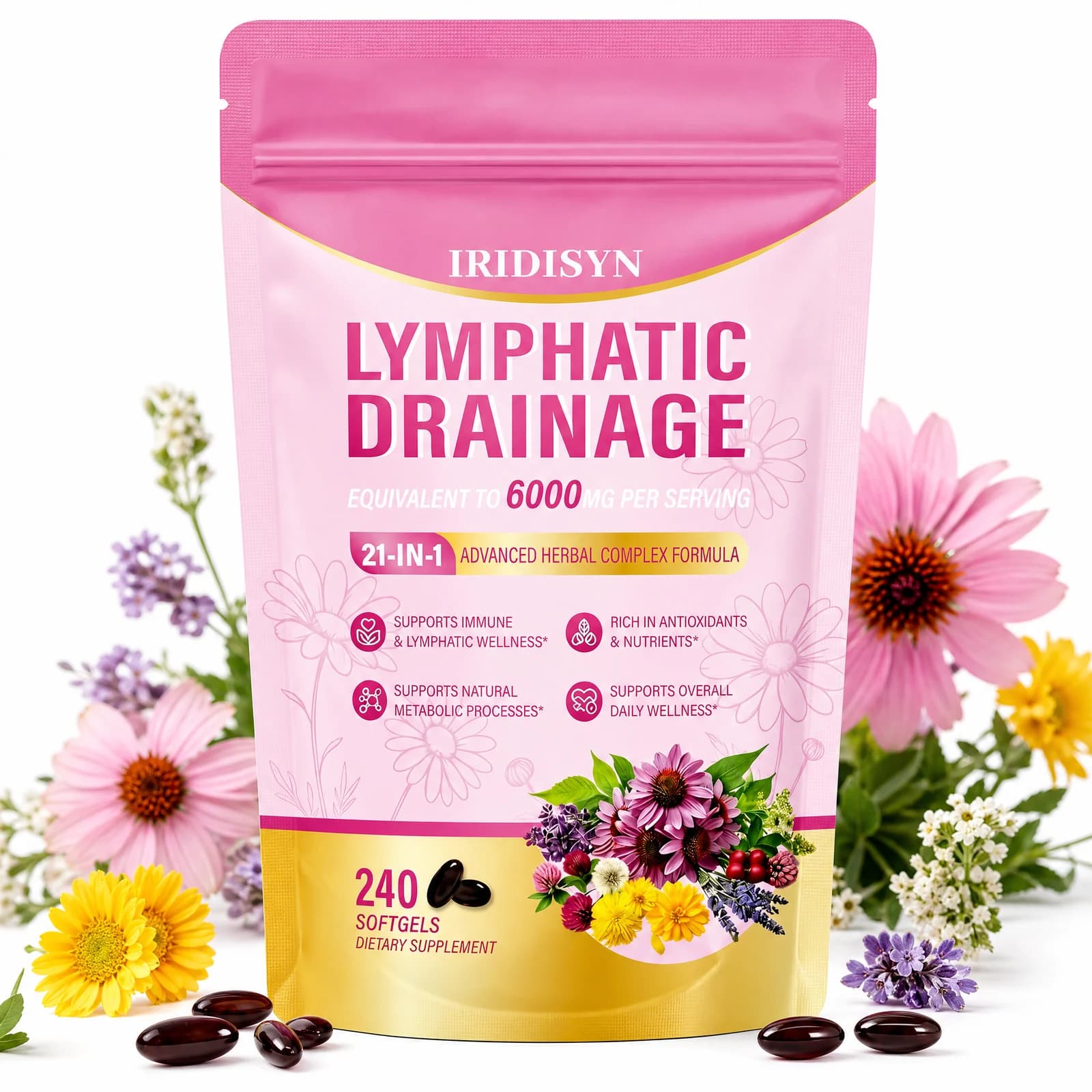
© IRIDISYN. Original asset from the IRIDISYN media library.
Educational content only. This page does not diagnose or treat lymphedema, swelling, or any other medical condition. New, persistent, painful, red, warm, or one-sided swelling should be assessed by a qualified healthcare professional.
Key takeaways
- Amounts are read per labeled serving, not automatically per capsule.
- Daily Value is a reference field, not a personalized treatment goal.
- Plant part, extract ratio, and constituent percentage are different details.
- Read other ingredients, suggested use, and warnings outside the facts panel.
Orient yourself on the panel
A Supplement Facts panel is used for dietary supplements. A Nutrition Facts panel is used for conventional foods. On a supplement panel, find the serving size and servings per container before reading the ingredient lines. FDA guidance on supplement nutrition labeling
Serving size and servings per container
Find the number of units or the measured quantity that defines one serving. A package count and a serving count are different. If a hypothetical bottle has 90 capsules and its label defines a serving as three capsules, it contains 30 labeled servings—not 90.
For a liquid, do not substitute drops, a full dropper, and milliliters for one another unless the actual directions define the relationship. A 60 mL bottle tells you package volume, not how much to take. If the serving directions are unreadable or unverified, ask for the final label instead of estimating.
Supplement Facts versus Nutrition Facts
The Daily Value column provides a reference for nutrients with established values. A botanical may instead carry a symbol indicating that a Daily Value has not been established. That symbol is not a claim that the ingredient is ineffective or a license to take more.
For example, a hypothetical 25% Daily Value is a reference-label percentage, not a statement that the product delivers 25% of a clinical benefit. Do not use the absence of a Daily Value to compare herbal potency or assign a personal target.
Work through the published softgels example
Read the example from top to bottom. The current softgels catalog records three softgels per serving and 80 servings per pouch. An entry on a serving-based panel applies to the complete serving. The listed extract ratio and amount belong in separate fields.
Amount per serving and % Daily Value
Keep the amount beside the entire ingredient line. For a botanical, record the name, plant part, and powder or extract description. An amount without that identity is incomplete comparison information.
For a hypothetical product declaring 120 mg per three-capsule serving, the arithmetic gives 40 mg per capsule. That calculation explains a label. It does not recommend taking one or three capsules. A manufacturer's serving and a safe personal decision are not the same question.
Common names are useful starting points but can hide differences. Nettle leaf and nettle root are different comparison entries. Elderberry and elderflower should not be treated as one preparation. Copy the botanical name and part exactly where they are supplied.
The nettle leaf guide and elderberry guide show why these distinctions matter. If a detail is absent from your panel, mark it as unknown rather than borrowing it from another product.
Plant parts, extracts, and blends
An extract ratio describes a relationship between starting material and extract. It does not automatically state the concentration of a specific constituent, a verified absorbed amount, or a clinical result. A ratio and a constituent percentage are separate fields.
Do not multiply a ratio into an efficacy score. Compare actual extract weight with actual extract weight, and an explicitly measured constituent with the same constituent. If a front-panel herb-equivalent total is used, keep it separate from the physical extract amount declared in the facts panel.
FDA's label guidance allows a proprietary blend total with component ingredients listed in descending order by weight. If only a total is given, the individual amounts are not available from that total alone.
Do not divide a blend evenly by its ingredient count. A hypothetical 600 mg blend with six named botanicals does not tell you that each is 100 mg. The missing individual amounts remain missing. The order is not a complete numerical recipe.
| Read this field | Catalog entry | How to read it |
|---|---|---|
| Serving size | 3 softgels | Read the listed amounts as applying to all three units together. |
| Servings per container | 80 | This is the number of labeled servings in the 240-count pouch. |
| Declared ingredient amount | Echinacea purpurea extract (10:1), 150 mg | Record 150 mg for the complete serving and 10:1 in the preparation field. |
| Proprietary blend | 40 mg total | Record the blend total. Check the package for the ingredients and any quantities it gives. |
Read beyond the main panel
Find the Other Ingredients statement and read the warnings, directions, and storage instructions. These details may appear elsewhere on the package. Photograph the full package when a pharmacist or clinician will need to review it.
Other ingredients, allergens, and directions
Look beyond the panel for shell materials, carriers, flavorings, preservatives, suggested use, warnings, and storage. These details can influence a format decision even when the front panels look similar.
Do not declare a product vegan, alcohol-free, allergen-free, or independently certified from an incomplete panel. If a dietary preference or allergy makes one of those fields important, seek explicit current information. A botanical ingredient list does not describe every material in a finished softgel or liquid.
A readable panel helps you understand what is declared. It is not an independent laboratory report and is not a trial of the finished product. If a quality seal or test report is claimed, verify the exact product and what the test covers rather than treating a decorative badge as evidence.
Likewise, a familiar herb and a precise-looking number cannot establish a lymphatic outcome. Ask whether the research matches the preparation and measured claim. It is possible for a label to be easy to read while the efficacy question remains unresolved.
Use the worksheet on another product
Use the printable record on a second product. Record exact wording where it affects interpretation. If a number is missing, mark it as undisclosed or ask the manufacturer before trying to compare it.
Record what is disclosed
Compare the current drops Supplement Facts and label context with the softgel Supplement Facts. Product-page amounts and serving descriptions come from the catalog and supplied artwork. Confirm the final package in hand.
These are separate formulas. Do not assume the same serving, botanical amounts, or other ingredients. In particular, IRIDISYN does not publish a liquid dose on the basis of an unverified dropper description. The comparison should make that uncertainty visible rather than fill it with an invented instruction.
Questions to ask when details are missing
Photograph all sides of the actual package and record the product name, date, serving, ingredient lines, other ingredients, and unresolved questions. Keep a second field for the intended outcome and the evidence, rather than writing the marketing claim into the ingredient field.
Bring the record to a pharmacist or healthcare professional when personal safety questions arise. You do not need to finish a purchase while a material label question remains unresolved. Clear comparison is the goal of the worksheet, not a larger supplement routine.
| Field | Your notes |
|---|---|
| Product, package, and date | ____________________________ |
| Serving and servings per package | ____________________________ |
| Ingredient, plant part, preparation, amount | ____________________________ |
| Blend disclosure and other ingredients | ____________________________ |
| Warnings, directions, and questions | ____________________________ |
Frequently asked questions
What is the difference between amount per serving and % Daily Value?
Amount per serving describes the quantity listed for the labeled serving. % Daily Value expresses the serving’s contribution to a specified reference value when one applies.
How do I record a blend when individual amounts are missing?
Record the blend name, total amount, and listed ingredients. Mark each individual quantity as undisclosed when the panel gives only a total.
- FDA guidance on supplement nutrition labeling
- NIH ODS: Dietary Supplements — What You Need to Know
- NCCIH: Using Dietary Supplements Wisely
- FDA: Questions and Answers on Dietary Supplements
- National Cancer Institute: Lymphedema
Sources are provided for transparency and further reading. Linking to an external source does not mean that the source endorses IRIDISYN or any IRIDISYN product.
Published by a supplement brand, not an independent clinical review service. Read our editorial standards or report a correction.