Cleavers for Lymphatic Support: Traditional Use, Evidence and Safety
Cleavers appears frequently in lymphatic teas and supplements, but frequency is not proof. Here is how to separate the plant's long history of use from the much narrower conclusions supported by modern research.
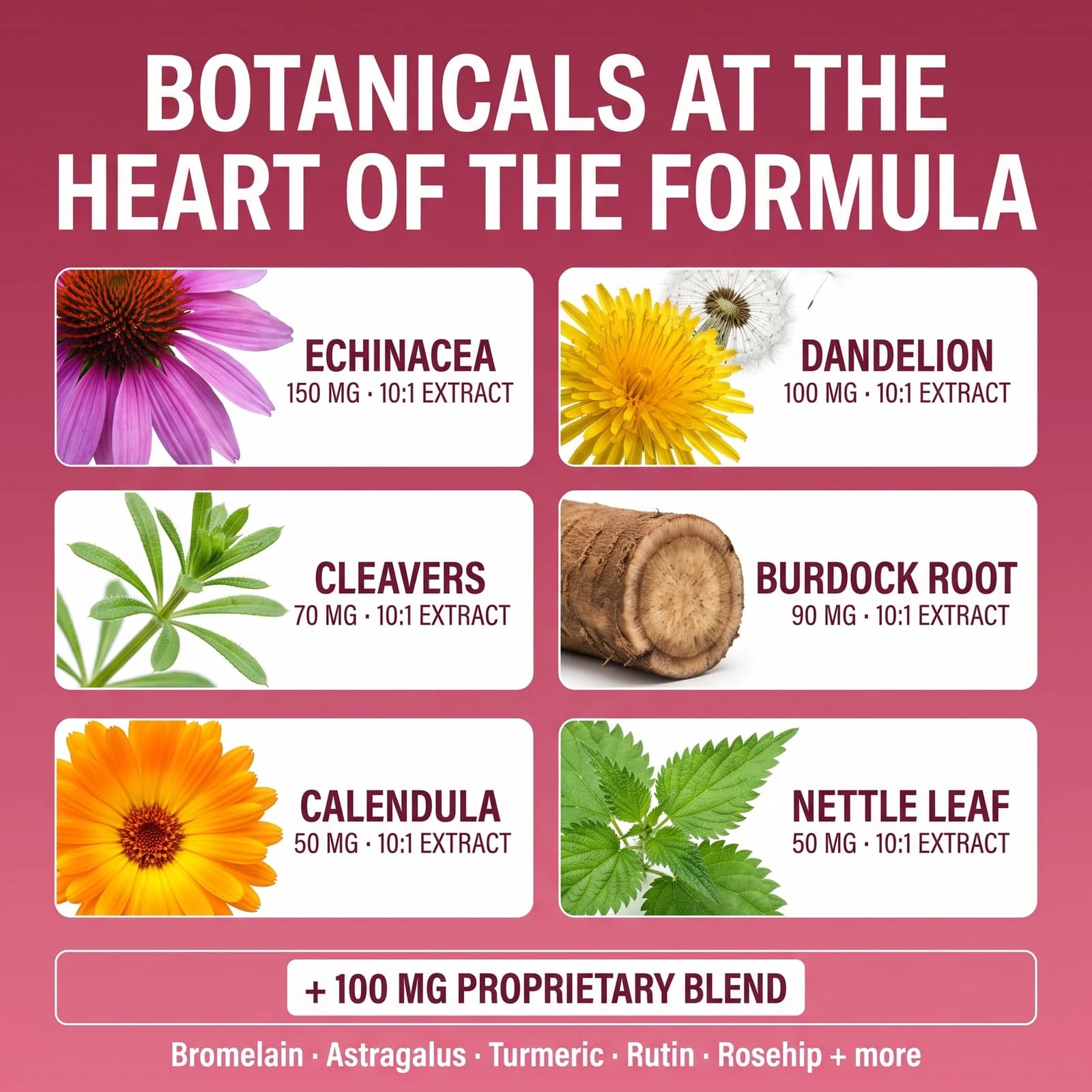
IRIDISYN original product artwork; shown for botanical context, not as clinical evidence.
Educational content only. This page does not diagnose or treat lymphedema, swelling, or any other medical condition. New, persistent, painful, red, warm, or one-sided swelling should be assessed by a qualified healthcare professional.
Key takeaways
- Cleavers is Galium aparine, but labels should also identify the plant part and preparation used.
- Traditional lymphatic or urinary use is historical context, not proof that an oral supplement changes human lymph flow.
- Published research includes laboratory work on cleavers infusions; this cannot establish a clinical lymphatic benefit.
- Because safety and interaction data are limited, a complete-label review and professional advice are appropriate when medicines or health conditions are involved.
What is cleavers?
Cleavers is the common name for Galium aparine, a scrambling annual plant known for the tiny hooked hairs that let its stems and fruits cling to clothing and animals. It is also called catchweed, goosegrass, or stickyweed. The aerial parts are used in teas, tinctures, liquid extracts, and multi-botanical supplements.
A common name does not fully identify a supplement ingredient. Check the Latin name, the plant part, whether the material is whole herb or extract, the extraction solvent when provided, and the amount per serving. Those details determine whether one product resembles another or resembles anything used in research.
Why cleavers became associated with lymphatic support
Herbal traditions have used cleavers in preparations associated with urinary function, skin complaints, and what modern marketing often calls lymphatic or cleansing support. That history helps explain why the herb appears in contemporary formulas, but it does not demonstrate that cleavers clears blocked lymph, treats swollen lymph nodes, or manages lymphedema.
Traditional-use records rarely answer modern clinical questions about standardized diagnosis, dose, preparation, comparison groups, and measured outcomes. They should be described accurately as traditional use rather than converted into a guaranteed mechanism.
What the research actually says
A published study indexed by PubMed examined the phytochemical profile, antioxidant behavior, and immunomodulatory activity of cleavers infusions in laboratory assays. It studied chemical fractions and cells, not people taking a lymphatic supplement, and it did not measure limb volume, lymph flow, lymphedema symptoms, or visible puffiness.
Laboratory findings can help researchers identify compounds and possible mechanisms. They cannot tell us whether an oral dose reaches the same concentration in the body, whether a finished blend behaves similarly, or whether the proposed outcome occurs in people. Direct, well-controlled human evidence for cleavers and lymphatic drainage remains limited.
| Evidence type | What it can contribute | What it cannot establish alone |
|---|---|---|
| Traditional use | Documents historical preparation and purpose | Modern clinical effectiveness |
| Chemical analysis | Identifies constituents in a tested sample | Absorption or benefit in people |
| Cell assay | Explores biological activity under laboratory conditions | A safe or effective oral serving |
| Human trial | Can test a defined preparation and outcome | Results for different species, extracts, or blends |
Cleavers research is not lymphedema treatment evidence
Lymphedema is a medical condition caused by impaired lymphatic transport and accumulation of protein-rich fluid. Assessment matters because swelling can also arise from infection, blood clots, venous disease, heart or kidney conditions, injury, medicines, and other causes.
Clinical management may include compression, exercise, skin care, and manual lymphatic drainage delivered or taught by trained professionals. A cleavers tea or supplement has not been established as a replacement for those approaches. New, sudden, painful, red, warm, or one-sided swelling needs medical attention rather than an herbal experiment.
How to read a cleavers supplement label
Look for Galium aparine, the plant part, preparation, and amount per serving. If the label says extract, check whether it supplies an extract ratio or solvent information. If cleavers appears inside a proprietary blend, the exact amount may not be disclosed.
Do not treat a concentrated-sounding ratio as proof of a stronger result. Also check the other botanicals in the formula. A multi-ingredient product must be evaluated as a complete formula, and a study of plain cleavers infusion cannot validate an extract blend containing many additional ingredients.
For the full framework, use the lymphatic supplement ingredient guide.
Cleavers safety and uncertainty
Reliable human safety data for concentrated cleavers supplements are limited. Product risk also depends on identity, contaminants, other ingredients, serving, duration, and the person's medicines and health conditions. Food-like familiarity with a plant is not enough to establish the safety of a concentrated extract.
Ask a clinician or pharmacist before use if you are pregnant or breastfeeding, preparing for surgery, giving the product to a child, using prescription medicines, or managing kidney, liver, immune, or other medical conditions. Stop use and seek appropriate help for an allergic reaction or other significant adverse effect.
The better question to ask about cleavers
Instead of asking whether cleavers is a lymphatic herb, ask whether a defined Galium aparine preparation has been shown in humans to produce the specific outcome promised at the labeled serving. Then ask whether the product in your hand matches that preparation and whether it is suitable for you.
For now, cleavers is best understood as a traditional botanical with interesting preclinical research and substantial clinical uncertainty for lymphatic claims. That is enough to justify careful study, but not enough to promise drainage, detoxification, reduced swelling, or treatment.
Frequently asked questions
Does cleavers help the lymphatic system?
Cleavers has a history of traditional use in lymphatic-support contexts, but direct human evidence showing that it improves lymph flow or treats lymphedema is lacking.
What is the scientific name for cleavers?
The botanical name commonly used for cleavers is Galium aparine. A useful label should also identify the plant part, preparation, and amount.
Is cleavers a diuretic?
Cleavers has traditional associations with urinary use, but a traditional description is not the same as robust human evidence. Increased urination would also not prove improved lymphatic drainage.
Can cleavers reduce swollen lymph nodes?
Do not use a supplement to self-treat enlarged or painful lymph nodes. Their cause should be evaluated by a healthcare professional, especially when persistent or accompanied by other symptoms.
Can I combine cleavers with other herbs?
Combination products add interaction and dose uncertainty. Review the complete formula with a pharmacist or clinician, especially if you use medicines or have a health condition.
- PubMed: Cleavers Infusion Phytochemical and In Vitro StudyA laboratory study of Galium aparine infusions; it is not a human clinical trial of lymphatic outcomes.
- NCCIH: Using Dietary Supplements WiselyConsumer guidance on supplement evidence, safety, quality, and conversations with healthcare professionals.
- NIH Office of Dietary Supplements: Dietary Supplements - What You Need to KnowAn overview of dietary supplement labels, regulation, safety, and independent quality testing.
- FDA: Questions and Answers on Dietary SupplementsFDA explanations of premarket review, supplement claims, labeling, and regulatory responsibilities.
- National Cancer Institute: LymphedemaPatient guidance on lymphedema symptoms, diagnosis, treatment, self-care, and urgent infection signs.
Sources are provided for transparency and further reading. Linking to an external source does not mean that the source endorses IRIDISYN or any IRIDISYN product.