Do Lymphatic Drainage Drops Work? Evidence, Claims and Safety
The short answer is that a liquid format can deliver botanical ingredients, but the format itself does not prove that a product improves lymph flow, reduces swelling, or detoxes the body.
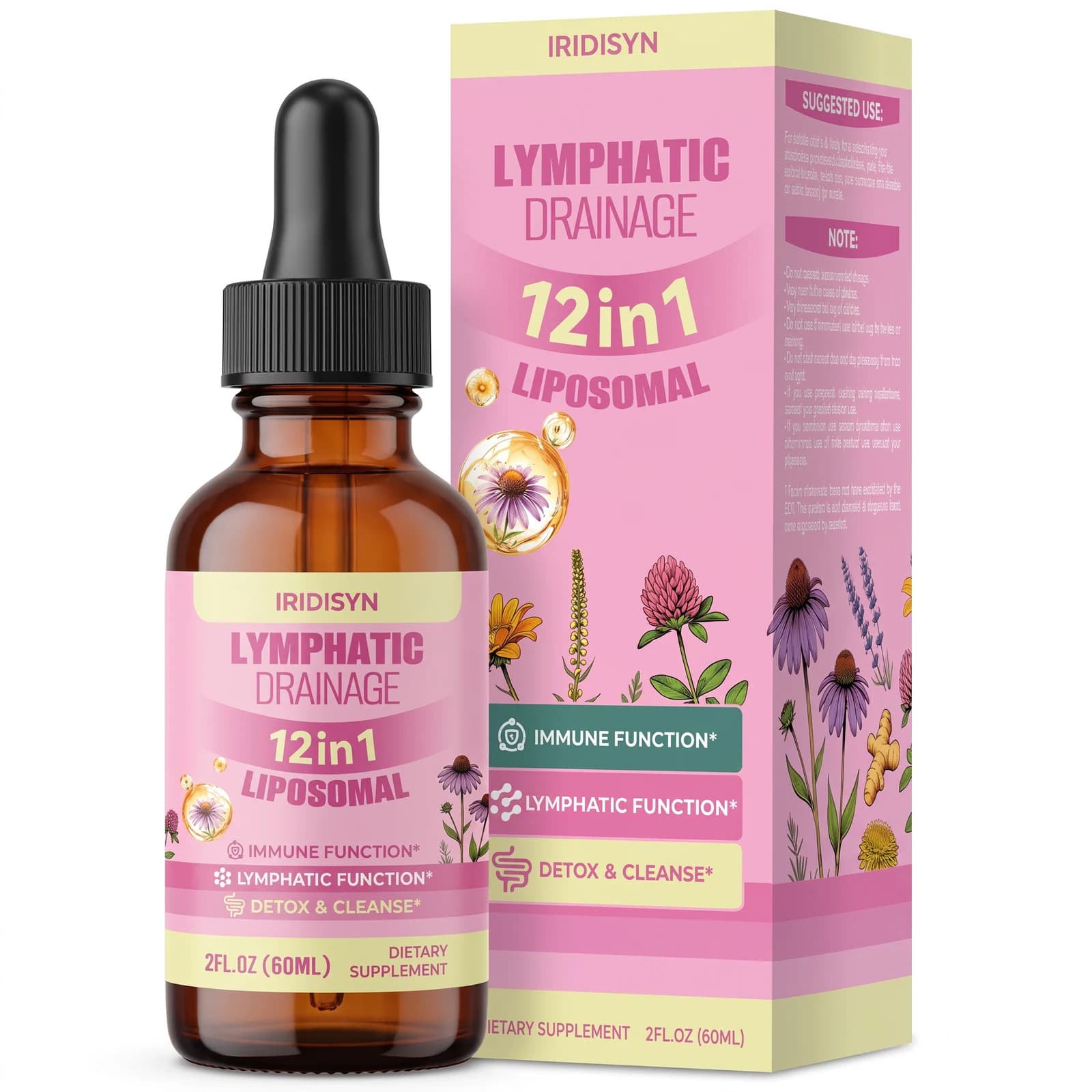
IRIDISYN original product photography. Packaging is shown for format and label context, not as clinical evidence.
Educational content only. This page does not diagnose or treat lymphedema, swelling, or any other medical condition. New, persistent, painful, red, warm, or one-sided swelling should be assessed by a qualified healthcare professional.
Key takeaways
- A dropper is a delivery format; it does not establish a lymphatic benefit.
- Evidence for an individual herb cannot automatically substantiate a multi-ingredient finished product.
- Diuretic activity, reduced puffiness, and improved lymphatic drainage are different outcomes.
- Use the complete label, individual risk factors, and healthcare guidance—not testimonials alone—to decide whether a product fits your routine.
The short answer
Lymphatic drainage drops can contain genuine botanical ingredients in a convenient liquid form. What they cannot establish by format alone is that those ingredients reach a target tissue, alter lymphatic flow, resolve swelling, or produce a detox effect. Those are separate claims that require relevant evidence for the finished formulation or for a sufficiently comparable preparation.
In the live search results and evidence reviewed for this guide, we did not identify high-quality human trials demonstrating that typical over-the-counter multi-herb lymphatic drainage drops improve lymph flow or treat lymphedema. That does not prove that every user will notice nothing. It means personal experiences and marketing language should not be presented as established clinical outcomes.
A responsible answer therefore has two parts: the product may be a usable way to take the ingredients listed on its label, but expectations about lymphatic drainage should remain limited unless direct human evidence supports the exact product and claim.
What lymphatic drainage drops usually are
Products in this category are commonly sold as tinctures, glycerites, liquid extracts, or blended liquid supplements. A dropper measures a liquid serving, while the active botanical material may be dissolved, suspended, emulsified, or combined with water, glycerin, alcohol, oil, flavoring, or other ingredients.
The word drops tells you how the product is taken. It does not tell you the dose, extraction method, concentration, stability, or quality. Two bottles with similar front-label language can contain different species, plant parts, extract ratios, serving sizes, and other ingredients.
Likewise, a count such as 12-in-1 describes the number of promoted components or formula concept; it should not be mistaken for evidence that the blend is stronger or more effective. More ingredients can also make it harder to identify which component caused an unwanted effect.
Four claims that should not be treated as interchangeable
Lymphatic-support marketing often moves quickly between drainage, fluid balance, less puffiness, and detoxification. They sound related, but they represent different biological or subjective outcomes. Evidence for one does not automatically establish the others.
| Claim | What it could mean | What would support it |
|---|---|---|
| Supports lymphatic flow | A measurable change in lymph movement or lymphatic function | Direct human measurement using an appropriate method and comparable formulation |
| Supports fluid balance | A broad phrase that may relate to intake, output, or tissue fluid | A defined clinical outcome rather than a general wellness impression |
| Reduces puffiness | A visible or perceived change that may have many causes | A validated measurement, comparison group, and a defined population |
| Detoxes or cleanses | Often undefined; the body already uses the liver, kidneys, lungs, gut, and other systems | A specific substance, pathway, measurement, and clinically meaningful result |
Why ingredient evidence does not automatically prove the blend works
Botanical research is preparation-specific. Echinacea research may involve one species, one plant part, and a standardized extract. Dandelion research may involve leaf in one study and root in another. Elderberry research generally focuses on prepared berry products rather than raw berries, leaves, or stems. A label that lists only a common name leaves important questions unanswered.
Dose also matters. If a study tests a known amount of one extract, a proprietary blend containing an undisclosed amount of that ingredient cannot be assumed equivalent. Even when every ingredient has some published research, the combination can have different absorption, interaction, tolerability, or stability characteristics.
Mechanistic plausibility is useful for deciding what to study next. It is not a substitute for outcome data. A plant that changes an inflammatory marker in a laboratory, for example, has not thereby been shown to move lymph fluid or reduce clinically diagnosed swelling in people.
Diuresis is not lymphatic drainage
Some herbs are discussed in relation to urination or traditional urinary use. Increasing urine output, if it occurs, acts through fluid handling by the kidneys. Lymphatic flow involves a separate vessel network and the return of interstitial fluid to circulation. The terms should not be used as synonyms.
Trying to change body fluid through a diuretic effect can also be inappropriate for people taking diuretics or medicines that affect blood pressure, glucose, electrolytes, or kidney function. A perceived decrease in puffiness does not identify the mechanism or the cause of the original swelling.
What about liposomal or fast-absorption claims?
A delivery technology can change how a particular compound behaves, but the word liposomal is not a universal proof of better absorption. The formulation must actually be characterized, remain stable through its shelf life, and be tested for the ingredient and outcome being claimed.
Better absorption, even when demonstrated, is not the same as better clinical results. It may increase exposure without proving benefit, and it can potentially change safety or interaction risk. A responsible comparison asks what was measured: particle properties, blood concentration, a biological marker, or an outcome that matters to the user.
Consumers usually cannot verify formulation performance from front-label language alone. Useful supporting information would include a clear technical description, testing relevant to the finished product, storage instructions, and evidence that connects the delivery system to a meaningful outcome.
How much weight should reviews and before-and-after photos carry?
Reviews can describe taste, ease of use, packaging, shipping, and how a product fit a routine. They are much less reliable for proving a health effect. Symptoms can fluctuate, users may change several behaviors at once, and expectations can influence what people notice.
A before-and-after image cannot show the cause of a visual change, whether lighting and timing were comparable, or whether the result will generalize to another person. It also cannot rule out a condition that needs medical attention. Testimonials should never replace appropriately controlled evidence for an objective health claim.
When reading reviews, look for transparent provenance, incentives, the original platform, and whether negative as well as positive experiences are represented. Treat a review as one person’s report, not a diagnosis, prescription, or guarantee.
A practical checklist for evaluating drops
First, read the entire label rather than only the front panel. The IRIDISYN label-reading guide explains serving size, amounts, Daily Value, proprietary blends, and other ingredients.
Second, compare the wording of the claim with the evidence. If the evidence relates to traditional use, the page should say traditional use. If it is a laboratory study, it should say laboratory study. If no direct human lymphatic outcome was tested, the copy should not imply otherwise.
Third, consider whether a liquid format creates a practical benefit for you. Drops may be easier for someone who dislikes pills, but they can also be less convenient for travel, have a noticeable taste, or require careful measurement. Those are legitimate format differences and do not require medical promises.
- Verify serving size and how the dropper is calibrated.
- Check every active and other ingredient, including sweeteners and solvents.
- Look for species, plant parts, extract ratios, and declared amounts.
- Do not assume a proprietary blend discloses enough information to match a study.
- Review medicines, allergies, pregnancy, breastfeeding, planned surgery, and health conditions with a qualified professional.
- Stop and seek advice if you develop an unexpected reaction.
What to do if swelling is the reason you are shopping
Do not use a supplement trial as a way to determine whether swelling is lymphatic. Swelling can result from many conditions, and the correct response depends on the cause. New, persistent, painful, warm, red, or one-sided swelling deserves professional evaluation.
People with diagnosed lymphedema should follow their clinical plan. The National Cancer Institute describes compression, manual lymphatic drainage as part of complete decongestive therapy, exercise, skin care, and other interventions delivered or supervised by trained professionals. A retail drop should not displace those measures.
For a broader explanation of that boundary, return to the lymphatic support hub. Then review supplement side effects and safety before deciding whether any formula is appropriate for your routine.
Frequently asked questions
How long do lymphatic drainage drops take to work?
There is no evidence-based universal timeline because products differ and a clinically established lymphatic effect has not been demonstrated for typical multi-herb drainage drops. A promised fixed timeline should be treated cautiously.
Do lymphatic drainage drops make you urinate more?
Some formulas contain ingredients discussed in relation to urinary output, but effects depend on the ingredient, preparation, amount, and individual. Urination is not proof that lymphatic drainage improved.
Can drops reduce a puffy face or swollen ankles?
Puffiness and ankle swelling have many possible causes. A temporary visual change does not identify the cause or prove a lymphatic effect. New, persistent, painful, red, warm, or one-sided swelling should be evaluated.
Are liquid supplements absorbed better than capsules?
Not universally. Absorption depends on the compound and complete formulation. A liquid can remove the need for a capsule to disintegrate, but that fact alone does not establish greater bioavailability or better outcomes.
Can I take lymphatic drainage drops every day?
Daily suitability depends on the exact formula, label directions, medicines, allergies, health conditions, pregnancy or breastfeeding, and duration of use. Follow the verified label and ask a qualified healthcare professional when those factors apply.
- National Cancer Institute: LymphedemaPatient guidance on symptoms, diagnosis, treatment, self-care, and urgent infection signs.
- National Cancer Institute: Lymphedema (Health Professional Version)Clinical background on lymphatic anatomy, lymphedema, risk factors, and management.
- NCCIH: Using Dietary Supplements WiselyConsumer guidance on supplement evidence, safety, quality, and healthcare conversations.
- NIH Office of Dietary Supplements: Dietary Supplements—What You Need to KnowAn overview of dietary supplement labels, regulation, safety, and quality.
- Federal Trade Commission: Health Products Compliance GuidanceGuidance on competent and reliable substantiation for health-related advertising claims.
Sources are provided for transparency and further reading. Linking to an external source does not mean that the source endorses IRIDISYN or any IRIDISYN product.